
First Jet Airways: The Airline Owned by Its Community
Category:
Civic Innovation
Read time:
11 min
Written by: Jessica Grace
About My Work on the Project
For the Wefunder campaign, I brought together input from leadership, aviation, legal, and financial stakeholders and shaped it into a cohesive investor narrative. I wrote the campaign page, telling the story of First Jet’s origins, strategic pivot, market opportunity, ownership model, and path forward. The campaign raised $1 million on its first day. As of November 6, 2026, it has raised more than $2.37 million from over 11,250 investors, and we’re working toward setting a new Regulation Crowdfunding record for the number of individual investors.
My work extends well beyond the Wefunder page. I’m creating a coordinated communications system across our website, owned content, email, investor updates, and social channels, along with the internal processes that support consistent content production. The goal is to give the team a strong foundation for telling the same recognizable story as First Jet grows—wherever and however people encounter the brand.
The campaign is still open. Read the campaign page and offering details on Wefunder.
Highlights
1. Building a low-cost, member-led airline with a nationwide community
2. Affordable, quality air travel because flyers hold voting control, not outside investors
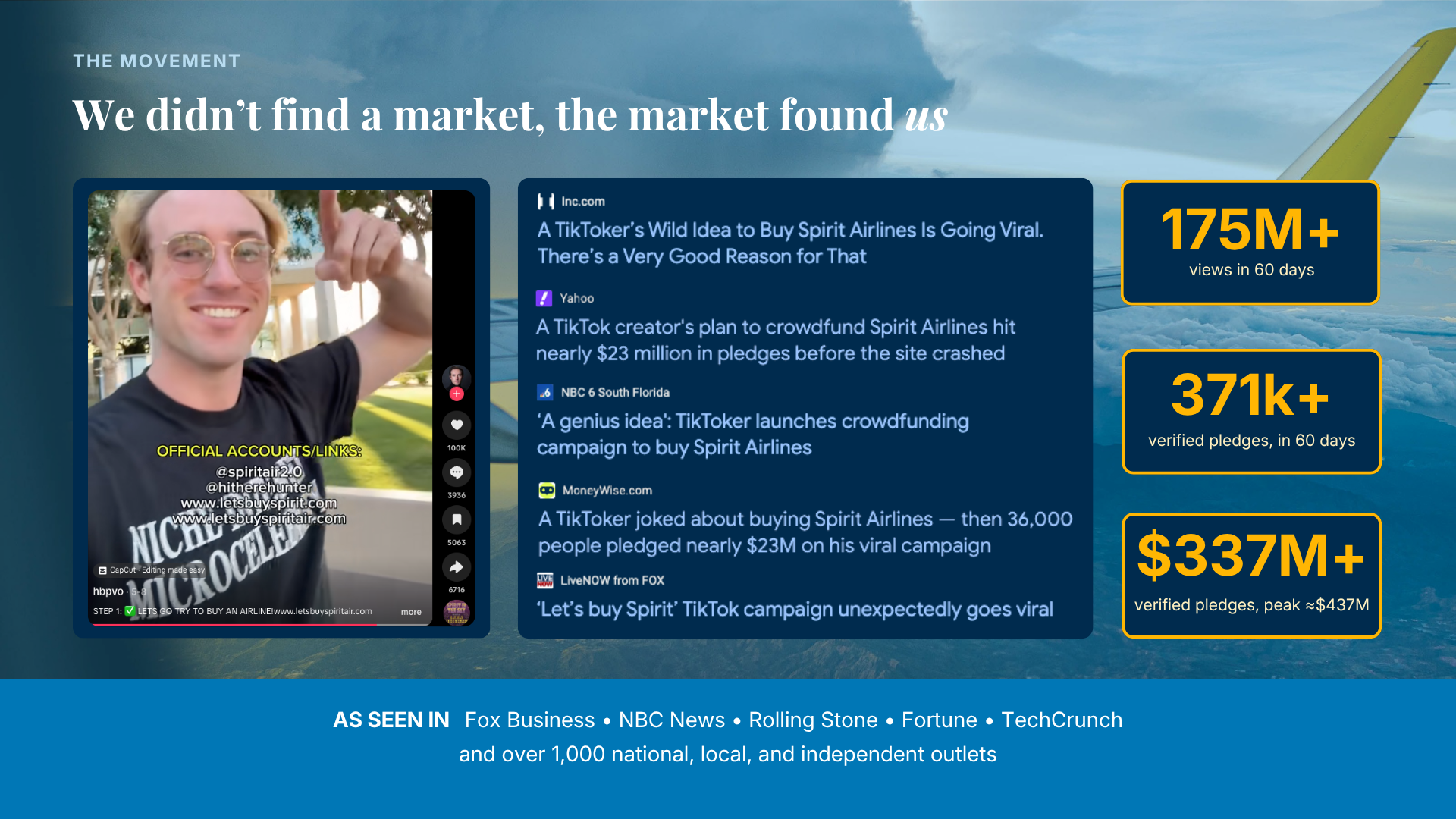
3. Began as a viral video to buy Spirit with 175M+ organic views within 60 days
4. Secured 370k pledges worth $337M and prepared a formal bid on Spirit
5. When the acquisition became risky, pivoted to building our own airline
6. Recruited a core team with founders in aviation, media, and community ownership
7. Completed diligence on a 24-month plan for FAA operating certification, passenger and cargo routes, crew, and fleet
8. Rallying the community for first flights by summer 2029
What if people who fly had a real, meaningful voice in air travel?
Air travel should be simple: a fair price, a dependable flight, and people who treat you like a person. Today, airlines charge more than ever, expect loyalty from travelers and workers, and give us no real say in our travel experience or the companies we help keep in the air.
What if we created a new airline?
First Jet Airways is the first airline owned and governed by the people who build it, the people who run it, and the people who fly it. We want to redefine who air travel belongs to by building an airline owned and shaped by its members.
More than 370,000 people raised their hands in support of this vision. They responded to a belief that felt both new and obvious: the people who make an airline possible should have a meaningful voice in what it becomes.
First Jet is being built from scratch, with a low-cost operating model, an annual membership program, and member governance at its core.
We are not adding a community feel to a conventional airline. Our community is how the airline is owned, funded, and held accountable.
We have formed the team to bring the vision to life. Now, we are inviting you to build it with us.
We didn’t find the market, the market found us!
On May 2nd, America lost its least expensive way to fly. Spirit Airlines ceased operations after 34 years. Its collapse displaced an estimated 30 million annual passengers. Many were families, vacationers, people traveling to see relatives, and people for whom a flight's price can decide whether the trip happens at all. 17,000 certified aviation professionals, from pilots to flight attendants, mechanics, and dispatchers, were released into the job market overnight.
The shutdown sent shockwaves through the aviation industry.

That same day, Hunter Peterson posted a video with a wild idea: what if ordinary people pooled their money and bought the airline?
For Hunter, aviation was not a random topic. He is a filmmaker, voice actor, and lifelong aviation enthusiast who has wanted to start an airline since he was seven. Spirit's online community also knew him from a video documenting 24 consecutive hours aboard its aircraft.
His proposal came down to simple math. If a small share of America's price-sensitive travelers chipped in the cost of one ticket, together they could theoretically buy the airline they depended on.
The idea resonated.
In less than 60 days, the campaign generated more than 175 million views. More than 371,000 people made non-binding pledges representing over $337 million in indicated support. Pilots, flight attendants, aviation operators, lawyers, cooperative specialists, technologists, and travelers began asking how they could help.
There was a clear signal that a large group of people wanted to participate in building an airline, not simply buy tickets from one. We did not have to wonder whether the idea mattered to anyone. The people answered.
Our Defining Moment
By June, the online campaign had become a serious effort. The team engaged aviation and securities counsel, began diligence on Spirit's assets, and raised $2.2 million from accredited investors to prepare a formal bid in bankruptcy court for Spirit’s operating certificate, brand rights, and airport gates.
But as the team dug into what acquiring Spirit would actually require, the risks became impossible to ignore. A compressed timeline, competing bidders, and uncertainty around liabilities tied to Spirit’s assets made the acquisition increasingly difficult to justify.
Faced with the choice between gambling community funds on a distressed, debt-laden asset or upholding financial discipline, Hunter and the team made the hardest call of the campaign: they withdrew the bid and returned 100% of the $2.2 million raised back to investors in full.
Buying Spirit for parts was the wrong plan. But the community's enthusiasm and desire to build something better were undeniable. We didn’t know it then, but walking away from Spirit 2.0 was the organization's defining moment.
Leadership realized that acquiring Spirit was never the true objective. The heart of the idea that inspired the movement was the chance to build an airline that worked differently for the people who relied on it.
Starting fresh meant giving up the fastest path. It also meant no inherited debt, no legacy fleet-maintenance burden, and no need to force a member-owned model into someone else's company.
We pivoted.
We are no longer buying an airline. We are building one.
Led by members, not mileage
Most airline loyalty programs work the same way. You spend money, collect points, and hope those points are worth something when you want to use them. The airline controls the rules and can change them whenever they want.
First Jet Airways is being designed around membership instead.
First Jet is being built from the ground up as a member-oriented, low-cost airline. The membership model is intended to create a relationship closer to a cooperative or membership business than a traditional frequent flyer program. Think “Costco for the skies.”
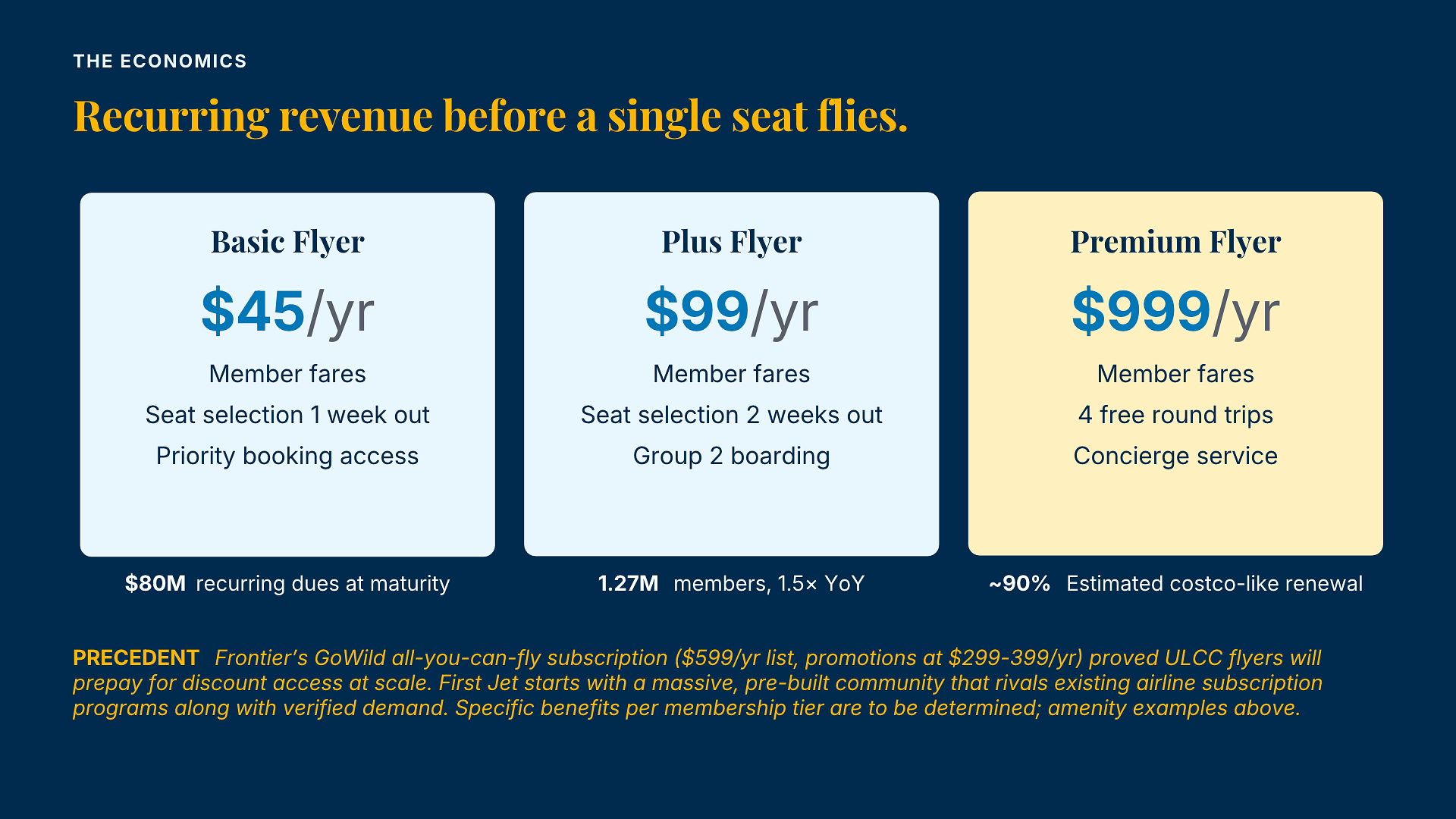
Members would receive access to member benefits and fares, while the cooperative structure gives member-patrons a meaningful role in governance. The current concept is an annual membership with access to member fares and practical travel benefits. Higher tiers would add more value for people who fly more often. Early planning has explored entry memberships at $45 and $99 per year, along with a premium tier.
There is also an economic reason to build it this way.
Annual dues can create recurring revenue alongside ticket sales. It also creates a deeper relationship between the company and the people it serves. Instead of spending indefinitely to reacquire the same customer for the next trip, **First Jet** is designed around a community with a reason to stay engaged with the airline over time.
Membership is not an add-on. It is part of how the airline is meant to work.
That combination of low fares, recurring membership, and broad-based ownership creates a category that doesn’t currently exist in U.S. commercial aviation.
The key difference is that membership is meant to do more than offer perks.
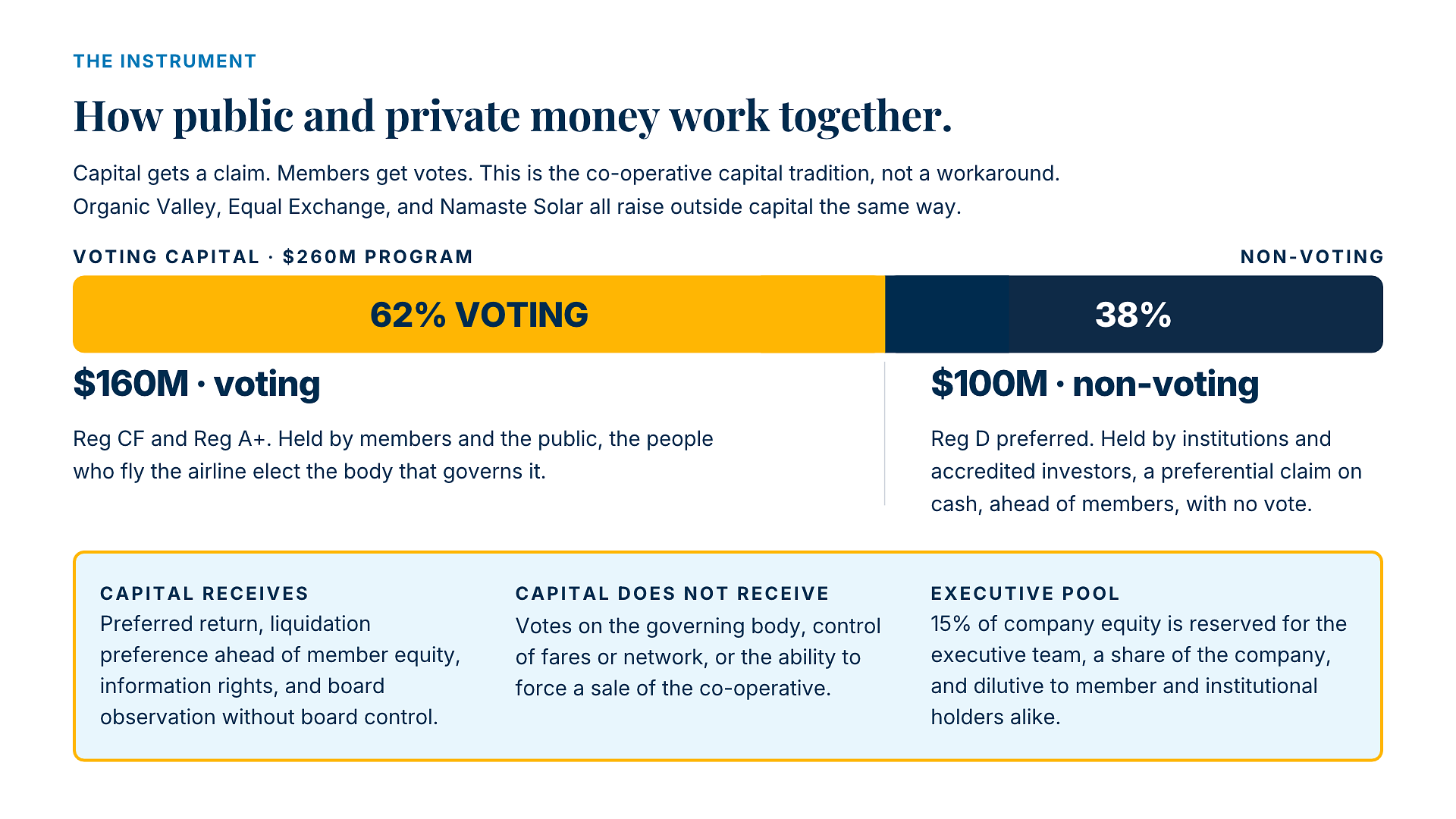
First Jet is being organized as a cooperative so that member-patrons, including the workers who build the airline and the people who fly it, hold meaningful governance rights. The intended structure calls for majority member voting power. Current planning allocates 62% of voting capital to member-patrons under a one-member, one-vote principle. The final structure remains subject to legal review and definitive documentation.
If the business produces an eligible surplus, a portion may be allocated back to members based on their activity with the airline. It is a way for the people who use the airline to share in the value their participation helps create.
We want membership to be useful enough that people renew because it continues to deliver value, not because they have points trapped in an account.
Building an airline is hard, but worth it.
There is an obvious question behind all of this: Can a community with a compelling idea actually build an airline?
That is the part of our story that we refuse to romanticize.
Commercial aviation is heavily regulated, operationally complex, and extraordinarily capital intensive. First Jet does not currently operate scheduled passenger flights, and the regulatory pathways contemplated in our planning remain subject to FAA, Department of Transportation, and other third-party approvals.
We consider that rigor a feature of aviation, not an obstacle to be waved away.
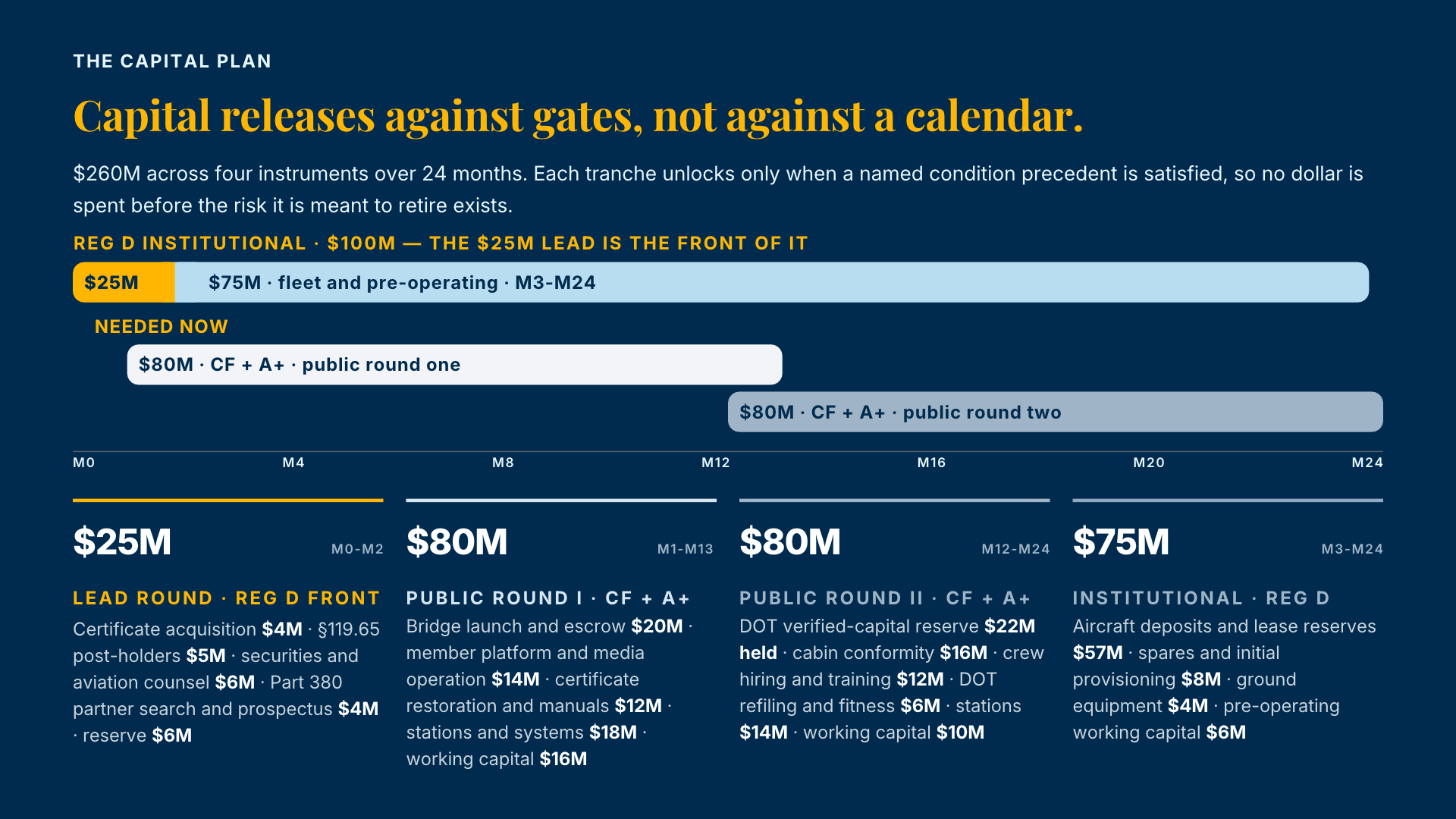
Our capital plan is built around milestones. Different pools of capital are intended to become available when specific regulatory and operating conditions are met. That approach connects each dollar to the risk it is meant to address, whether the next step involves leadership, certification, aircraft, systems, or working capital.
We plan to start passenger flights in summer 2029. Our exact date depends on financing, third-party agreements, aircraft availability, qualified personnel, and regulatory approval.
The team has engaged corporate, securities, and aviation counsel. It has completed operating-specification diligence and brought together more than 50 operators and contributors with experience across aviation, technology, cooperative ownership, and media.
This Wefunder offering is one part of that plan. It is not the full cost of launching a commercial airline. The offering materials explain what this round is intended to fund and the terms on which people can invest.
We would rather be clear about the work ahead than make the road sound easy.
Why invest at this stage?
First Jet Airways is early. FAA certification could take longer than planned. The company may need more capital than expected. Interest may not convert into paid memberships at the rate our plans assume. Aircraft, labor, insurance, fuel, and regulation can all change. Investors could lose their entire investment.
Those risks are real. So are the things First Jet has already demonstrated.
Before the airline existed, the idea generated more than 175 million organic views and more than 371,000 verified pledges worth over $337 million in indicated support. Spirit's collapse left an estimated 30 million annual passengers looking for alternatives. When the proposed acquisition became too risky, the team returned $2.2 million instead of pushing through a bad deal. Since then, **First Jet** has been building its governance, membership model, capital plan, and operating strategy from the ground up.
None of that guarantees success. It does show demand, judgment, and a reason for this company to exist.
The opportunity is bigger than launching another low-cost carrier. First Jet is working to combine affordable travel, recurring membership, cooperative governance, and broad community participation in one airline. The goal is a company that earns loyalty by delivering value and giving its members a meaningful voice.
That is a difficult company to build. We believe it is worth building
Now boarding…
First Jet began with a question about who an airline could belong to.
A video became a movement. The movement revealed demand. Walking away from Spirit gave the mission focus. Now comes the long, practical work of turning that mission into a safe, reliable operating airline.
We are not asking anyone to invest because starting an airline is easy. We are asking people to consider the need for affordable service, the community that formed before the product existed, the judgment shown when the first plan stopped making sense, and the value of an airline shaped by the workers who build it and the people who fly it.
Read the offering materials. Understand the risks. Then decide whether you want to be a part of the First Jet story.
We are inviting you to build an airline for the people, by the people, and because of the people, with us.
This is First Jet. Welcome aboard.

Jessica Grace is a seasoned marketing strategist and fractional CMO specializing in early-stage startups and visionary entrepreneurs. With a sharp eye for brand storytelling and data-driven growth, she transforms ideas into impactful, values-driven brands.
Follow me: