Still Processing...
Subscribe to my newsletter. Expect deep dives exploring our current cultural moment, embodying our vision, and build a better future.

Quick Snapshot
- Client:
- Clef , a blockchain-enabled identity security startup, Oakland, CA (acquired by Twilio)
- Role:
- CMO, founding marketing hire, brand, messaging, and go-to-market
- Industry:
- Emerging internet security, nascent blockchain and crypto category
- Engagement Length:
- 18 Months
- Scope:
- Brand architecture and voice
- Audience-specific messaging systems for three distinct audiences
- Public launch strategy and communications
- Community building and culture strategy
- Enterprise sales program and content
- Results:
- Built a fully original, human-centered brand in a technical industry.
- 45% month-over-month user growth
- Led a successful public launch and supported a profitable acquisition by Twilio.
- National press and multiple awards including recognition from the Oakland Chamber of Commerce
A presentation for a large crypto conference.
A guide to creating layered messaging that lands with different stakeholders—without creating confusion or compromising brand coherence. Based on your real-world experience building B2B2C brands.
A sharp, principled piece on how early-stage teams often treat culture as decoration or post-launch fluff—when in reality, it’s the invisible system that shapes everything: communication, decision-making, conflict, trust, equity.
The Situation
When a technical product needs to earn trust from engineers, business buyers, and everyday end users all at once, the marketing challenge is not one problem. It is three separate translation problems that all have to resolve into one coherent brand. That is what Clef was facing. The product was genuinely sophisticated: blockchain-enabled, passwordless two-factor login. The founders had conviction, a name, a logo, and a few colors. What they did not have was a way to talk about what they had built to anyone outside the technical community. The engineers who would evaluate it, the business buyers who would approve it, and the people who would actually use it every day did not share a language. Nobody was holding the whole picture. That was the job.
What We Found
The product was technically credible and the founding team knew exactly what they were building. What had not been built yet was everything a market-facing company needs: a brand, a voice, a system for translating a complex product into something that landed differently for three very different readers. The internet security category made this harder, not easier. The conventions of the space were fear-based messaging, lock-and-key visuals, and jargon that kept ordinary users at a distance. The default assumption was that complexity was a feature. Clef's actual product worked the opposite way: it made security invisible to end users, fast to integrate for engineers, and easy to trust for business buyers. The gap between what the product did and how the category communicated was the strategic opening. Building into that gap, coherently, for all three audiences, was the foundation everything else would need to stand on.
The Approach
A brand built to contradict the category
The first work was building Clef's full brand identity, because the category had already told us exactly what not to do. Every other security company was austere, technically intimidating, or designed to make users feel like they needed to be managed rather than served. The opportunity was a deliberate departure: not differentiation from competitors, but from the emotional register of the category entirely. We developed voice, values, visual language, and positioning from the foundations up, starting from what already existed and building outward from there. The result was a brand that felt warm, open, and human in a space that had trained people to expect the opposite. Clef would be a friend in the security business. That was the strategic choice, and it was not subtle.
A modular messaging system for three audiences
We built a structured messaging architecture because the three audiences Clef needed to reach could not be served by a single voice, and trying to average across them would have served none of them well. Engineers needed technical transparency and precise language. Business decision-makers needed high-level value and clear trust signals. End users needed onboarding so straightforward it required no explanation. The solution was a system: one coherent brand personality translated into three audience-specific frameworks. Everything produced, from API documentation to onboarding guides to sales collateral, drew from the same foundation and landed in the right register for whoever was reading it. The brand held across all three audiences without fracturing, because the underlying architecture was specific enough to survive translation.
A community-first launch and early vertical strategy
We built the public launch strategy around community rather than media, because Clef's credibility would be built through relationships and presence, not announcements. We hosted events that brought together the startup ecosystem, crypto pioneers, privacy advocates, and emerging blockchain players. We positioned founders and engineers as voices in the broader conversation. Alongside this, the team made a shared strategic decision to pursue the nascent blockchain and crypto vertical, analyzing where we could realistically win early clients and committing to learning that space with real depth. It was early. It was still being defined. That turned out to be exactly the right time.

What Changed
Clef's founders could send anyone, an engineer, a business contact, a potential partner, somewhere that explained what the company was and why it mattered, in terms that worked for whoever was reading it. The marketing no longer required a founder in the room to translate. The story traveled on its own.
From there, the results compounded. User growth reached 45% month-over-month through coordinated campaigns, content, and events. The public launch generated national press coverage and positioned Clef as a standout in the security space. The company earned multiple awards including recognition from the Oakland Chamber of Commerce for culture and communications. The early vertical work in blockchain and crypto created the strategic conditions that led to a successful acquisition by Twilio.
The coherence was not incidental to the outcome. It was the precondition for it.
- 45% month-over-month user growth through campaigns, content, and events
- Successful acquisition by Twilio
- National press coverage and industry recognition
- Multiple awards including recognition from the Oakland Chamber of Commerce for culture and communications strategy
- Full go-to-market messaging and brand materials built and deployed for three distinct audiences
- Modular sales content, technical documentation, and onboarding systems built from zero
A Note on This Work
The hardest problem at Clef was not building three different messaging systems. It was keeping them from becoming three different brands. The pressure in this kind of work is always toward fragmentation: make this landing page technical, make that one simple, make this other one about business value. You can optimize each piece locally and lose the thing that makes all of it work, which is that it sounds like one company that knows what it stands for.
The modular system held because the brand personality was specific enough to survive translation across very different contexts. Specific values. A clear point of view on what security should feel like for people who do not want to think about security. A deliberate decision to sound nothing like anyone else in the category.
What I find most interesting about this engagement is that the constraint that seemed biggest, three completely different audiences with three completely different needs, turned out to be the clearest brief I could have been given. When you know exactly who you are talking to and what each of them needs to believe, the work has direction. The problem most founders have is that they have not named those audiences specifically enough to build for them. Once they do, the translation becomes possible.
What It Looked Like in Action
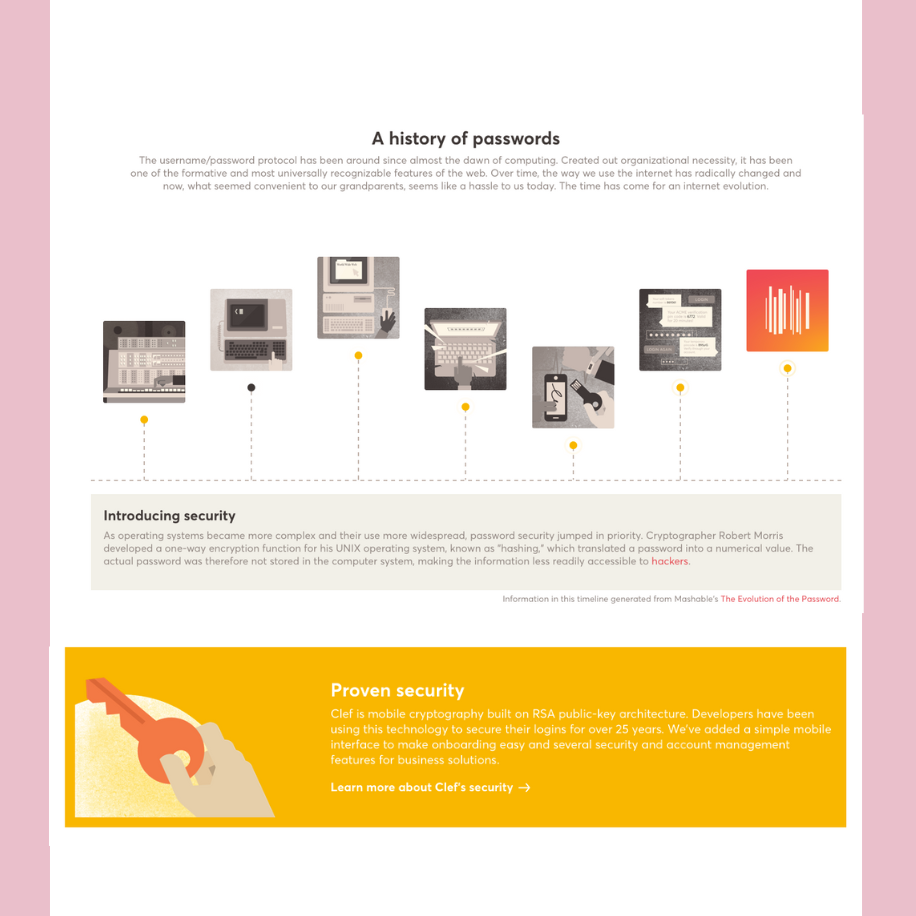
A brand strategy is only as useful as the form it takes. These pages are from the Clef brand system developed during the engagement. They show how one coherent brand personality moved across audiences, contexts, and use cases. Warm and human in a category that had trained people to expect the opposite.



Kind words from clients


